A 1978 airfare benchmark now values rides on company jets
 FlightCal team
Twice a year the Department of Transportation recalculates a fare benchmark that Congress wrote in 1978 for a regulator that no longer exists. The Internal Revenue Service then uses it to decide what a seat on a company jet is worth.
The Airline Deregulation Act didn't free fares in one step. It defined a "standard industry fare level": the fare in effect on July 1, 1977, for each pair of cities and class of service, adjusted at least twice a year by the change in airlines' operating cost per available seat-mile. The Civil Aeronautics Board could no longer call a fare unreasonable if it sat within 5 percent above that level or 50 percent below it, with exceptions for predatory cuts and for carriers that dominated a route.
The same law ended the Board's power over interstate fares on January 1, 1983, and set the Board itself to shut two years later.
Federal tax rules still use the benchmark to price a trip that has no ticket: a personal flight on an employer's aircraft. Treasury's rule names its method "the Standard Industry Fare Level formula": a terminal charge plus a per-mile rate that steps down after 500 and 1,500 miles, with the mileage part multiplied by a percentage set by the aircraft's weight and by who is on board.
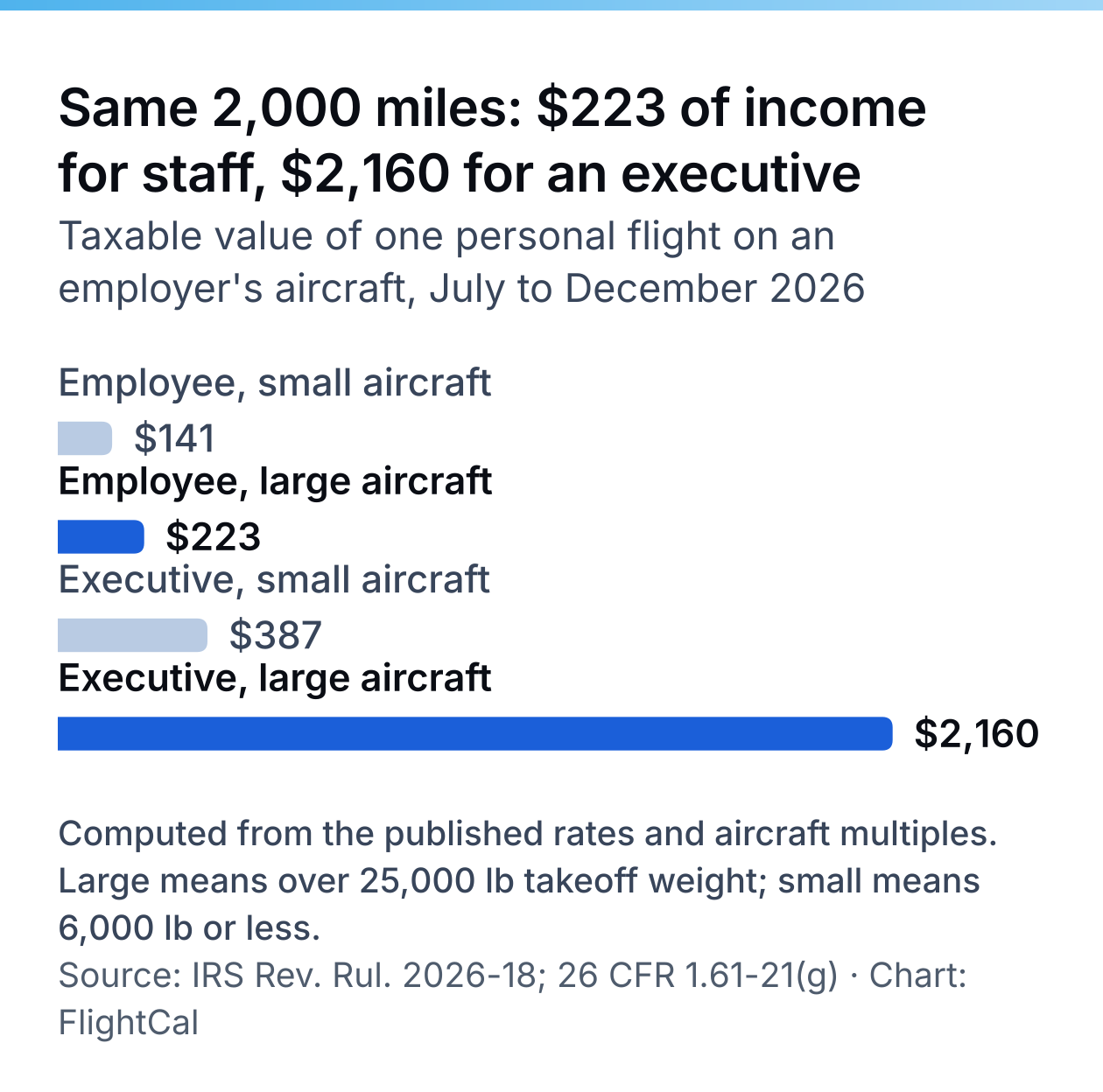
For flights from July 1 through December 31, 2026, the IRS lists a $58.95 terminal charge and rates of 32.25, 24.59 and 23.64 cents a mile. The rule works one example itself: a rank-and-file employee flying 2,000 miles on a 26,000-pound aircraft in January 1989, valued at $100.36. Run that example through the rates for the second half of 2026 and the trip counts as $223.38 of income.
Now seat a "control employee" there instead: a director, a 5 percent owner, or one of the company's top officers or highest earners. On an aircraft over 25,000 pounds the multiple rises from 31.3 percent to 400 percent, and the same example trip becomes $2,160.35.
The regulation has a plan for the day DOT stops doing the arithmetic. If the calculation "is discontinued," the IRS Commissioner may prescribe a different formula. Until then, a benchmark Congress wrote in 1978 to limit a fare regulator still prices the seats that have no fare.
Sources
- Airline Deregulation Act of 1978, Public Law 95-504, 92 Stat. 1705 (sections 37 and 40 at 92 Stat. 1741-1745)Accessed November 13, 2026
- 26 CFR § 1.61-21 - Taxation of fringe benefits (Cornell Legal Information Institute)Accessed November 13, 2026
- Internal Revenue Bulletin: 2026-42 (Rev. Rul. 2026-18)Accessed November 13, 2026