The DOJ said American's Dallas–Atlanta fare was a message to Delta
 FlightCal team
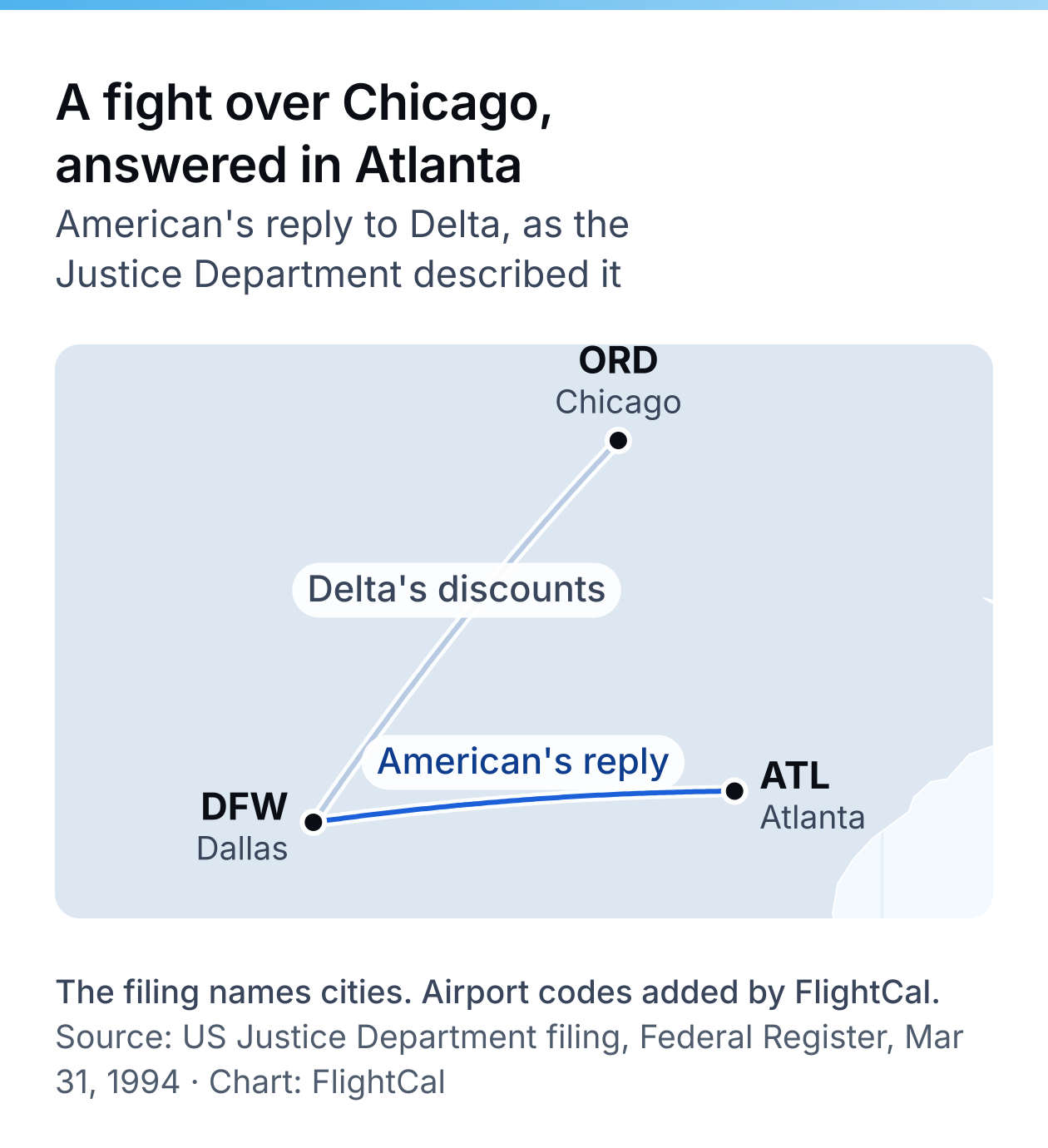
American Airlines filed discount fares between Dallas and Atlanta, two Delta hubs, in a fare dispute that began in April 1989. The Justice Department later argued that those fares were a proposal to Delta, written in fare levels, a footnote code and a last ticket date.
The dispute was over a different route. American had offered discounts between its hubs in Dallas and Chicago on a few flights a day. Delta put them on all its flights on that route, because demand was low. American matched, but gave its fares a last ticket date only days away, and refiled the discounts on two flights with a first ticket date still ahead. At the same time, it filed Dallas–Atlanta fares with the same dollar amounts, the same footnote code and the same last ticket date.
A Delta pricing employee called the Atlanta fares an "obvious retaliation." Delta withdrew its Chicago discounts and refiled them on two flights only. American pulled the Atlanta fares before their last ticket date. By the government's account, many Dallas–Chicago travelers paid up to $138 more per round trip.
The channel, the government said, was Airline Tariff Publishing, the database the airlines jointly owned for sending out fares. Any fare could carry up to two footnotes, with codes such as "A" or "32." It could also carry a first ticket date, which let an airline publish a price rise before anyone could buy at that price. Rivals could then match it, counter it or stall.
Travel agents couldn't follow this. Their reservation screens showed fares one market at a time, with no footnote codes. The airlines ran software that sorted the filings into daily reports for tracking rivals' proposals.
The Justice Department sued eight airlines in December 1992, identifying over 50 agreements across hundreds of city pairs, from New York–Chicago to Klamath Falls–Tampa. A 1994 filing added that ticket dates were little use to consumers: on average they were inaccurate 54 percent of the time. Antitrust chief Anne Bingaman compared the filings to conversations "by conspirators over the telephone or in hotel rooms."
The airlines settled without admitting anything. First ticket dates were banned, every fare in the system had to be on sale immediately, and the judgment was written to expire after ten years.
The economist Amalia Miller later measured what that bought. Fares fell during the investigation and rose after the settlement. Her verdict on the case: "at best a temporary effect on airline collusion."
Sources
- United States v. Airline Tariff Publishing Co.: Proposed Final Judgment and Competitive Impact Statement, Federal Register, March 31, 1994Accessed November 6, 2026
- Justice Department Settles Airlines Price Fixing Suit, May Save Consumers Hundreds of Millions of Dollars (press release, March 17, 1994)Accessed November 6, 2026
- Amalia R. Miller, Did the Airline Tariff Publishing Case Reduce Collusion? Journal of Law and Economics, 2010Accessed November 6, 2026